
Claudia Reyes bought her first home in Cedar Park, north of Austin, in the spring of 2021. It was a 1987 build with good bones, a screened porch she loved, and a kitchen that looked exactly like a kitchen from 1987. She budgeted ninety thousand dollars for a renovation and started calling contractors in June.
By August she had four different quotes in four different formats, three unanswered follow-up texts, one contractor who’d visited twice and not submitted anything, and a folder on her laptop containing a spreadsheet, two PDFs, seventeen photos, a hand-drawn sketch she’d made during a showroom visit, and a note app full of cabinet dimensions she was pretty sure were from two different measurements.
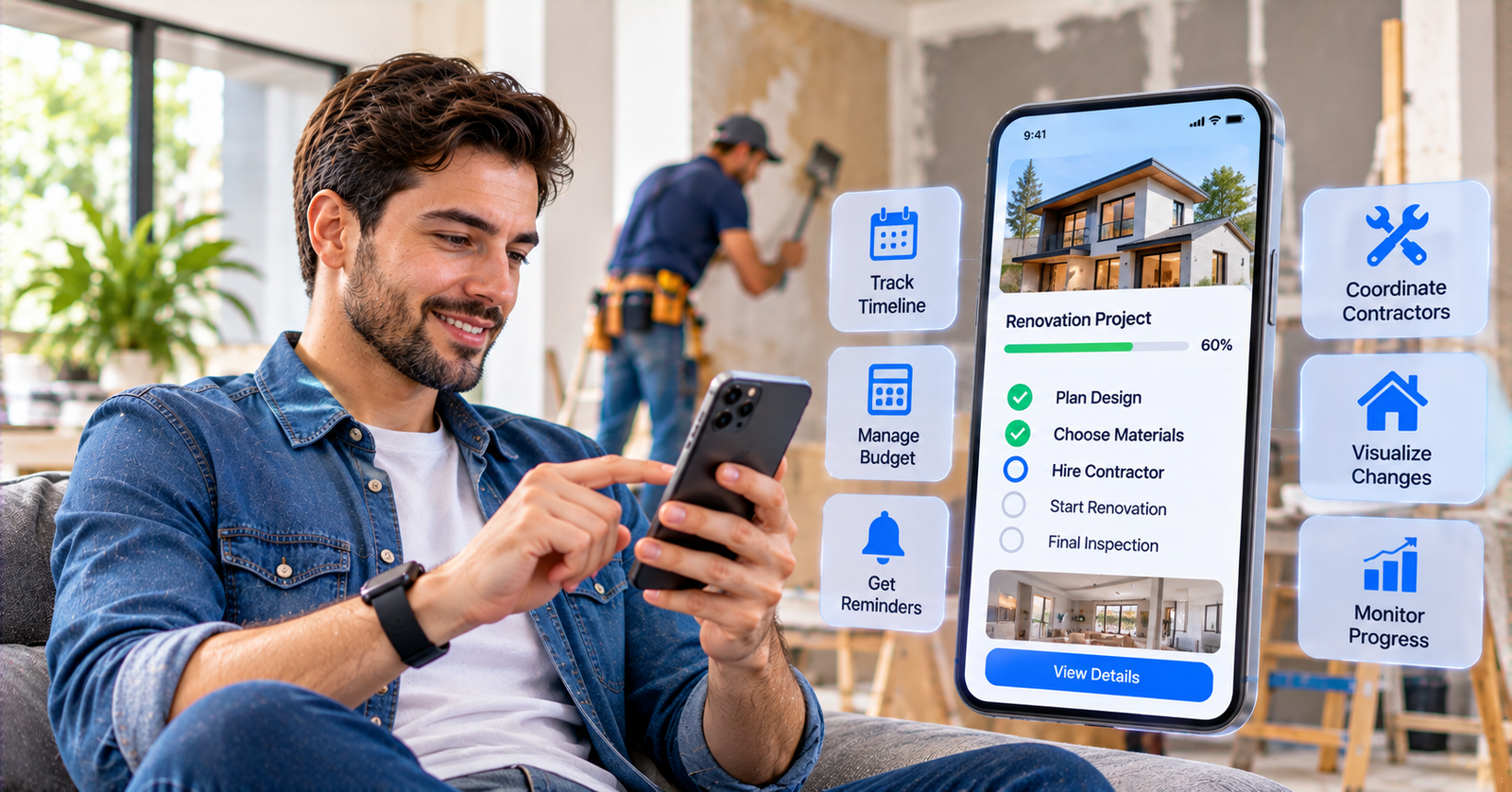
A friend who’d renovated a house in South Austin the previous year told her to download the app she’d used. Not to hire contractors or find materials. To manage the whole project: timeline, budget, communication, decisions, and documents, in one place she could open from anywhere and share with anyone involved.
Claudia found that the friend had also worked with a Mobile App development company in Austin through her architecture firm, and the two had built a project coordination tool for a specific kind of client, the detail-oriented homeowner who wanted to understand every decision rather than hand it off and hope. The commercial app Claudia used was different, but the problem it solved was the same: renovation projects are information-management problems as much as they are construction problems, and the construction industry had historically left the information-management problem entirely to homeowners who had no tools for it.
She finished the kitchen renovation eight months later, one week behind schedule and four thousand dollars under budget. The numbers don’t tell the whole story. What they tell is that she had the information to make the tradeoffs that produced those numbers, rather than finding out at the end what she’d spent and what had slipped.
The Renovation Problem Nobody Names Correctly
Ask anyone who has managed a home renovation what was hardest and most people describe something that sounds like project management rather than construction. Coordinating when trades show up. Tracking what’s been approved versus what’s pending approval. Following up on lead times for materials that were supposed to be ordered weeks ago. Maintaining a coherent picture of where the budget stands when costs keep changing.
These are information management problems. The tile subcontractor doing excellent work is not making those problems worse. The absence of a system that connects what he’s told the GC about lead times to the homeowner who needs to make a selection decision before the counter goes in is what makes it difficult.
The construction industry has had project management software for decades, but it was built for contractors and construction companies, not homeowners. Procore, Buildertrend, and CoConstruct are powerful platforms serving professional builders who manage multiple projects simultaneously. They are not what a homeowner managing one renovation once in their life needs, and the complexity and cost of those tools reflect that.
The gap between professional construction software and nothing was what consumer-facing renovation apps moved into, and they did it by thinking about the homeowner’s information problems specifically rather than adapting contractor tools for a consumer audience.
Finding and Vetting Contractors Through Apps
The contractor problem was what most people encountered first when home improvement apps emerged, and it’s what platforms like Angi, formerly Angie’s List, Houzz Pro, Thumbtack, and HomeAdvisor built their early audiences around.
The fundamental change these platforms made was aggregating contractor reviews in a searchable form, which shifted the information balance between homeowners and contractors. Before review platforms, finding a good contractor required referrals from people you knew, and if you didn’t know anyone who had recently renovated something similar, you were largely guessing.
Review platforms made collective experience searchable and filterable. A homeowner looking for a tile installer in Cedar Park could see reviews from people who’d hired tile installers in that area, filter by project type, see before-and-after photos, and get a rough sense of pricing before making a single call.
The limitation of review platforms became visible over time. The reviews are real but selective: contractors tend to ask satisfied clients to review while unsatisfied clients write reviews unprompted. The projects that show up in portfolios are the photographer-friendly ones, not the complex ones where the contractor’s problem-solving mattered most. And the platform’s business model, charging contractors for leads, creates incentives that sometimes produce aggressive follow-up from contractors who bought the lead rather than contractors who are the best fit for the project.
Apps that focus on vetting rather than just reviewing have tried to address this. Porch and similar platforms offer background checks and license verification alongside reviews, which improves the baseline information a homeowner has before the first call.
Budget Tracking That Doesn’t Require a Finance Degree
The renovation budget is one of the most common sources of homeowner distress, and it’s worth understanding why budgets go wrong before describing how apps help.
A renovation budget looks simple in a quote. Materials plus labor equals total. What it hides is the difference between the quote and the contract, the difference between the contract and the actual costs that emerge once walls are open, and the difference between the original scope and the scope as it evolves when the homeowner makes changes or when the conditions behind the walls turn out to be different from what anyone expected.
Each of those gaps is real and expected by experienced contractors and entirely opaque to first-time homeowners. The contractor who quotes forty-two thousand knows the quote has assumptions that may not hold. The homeowner who signs for forty-two thousand believes the total is known.
Budget tracking apps help not by eliminating these gaps but by making them visible in real time rather than as a surprise at the end. An app that shows the original budget, the current contract value, the approved change orders, the pending decisions that will affect budget once made, and the remaining contingency gives the homeowner a live picture of their financial position rather than a point-in-time snapshot.
Houzz, Buildertrend’s homeowner portal, and tools like Build on Budget built for residential renovation each approach this differently. What they share is the attempt to give homeowners visibility into the budget’s moving parts rather than a single number that doesn’t reflect what’s actually happening.
Claudia’s four thousand dollar savings came partly from one specific decision: when a lead time problem threatened to delay cabinet installation and the contractor proposed an upgrade that happened to be in stock at the same price, the app had her target budget visible and her contingency line itemized clearly enough that she could evaluate the offer against real numbers rather than gut feeling. She accepted it. The timeline held.
Managing Decisions Before They Become Crises
Renovation projects are a cascade of decisions. Some are major: the cabinet style, the countertop material, the floor tile. Some seem minor but have downstream consequences: the outlet placement in the kitchen island, the niche dimensions in the shower, the direction the herringbone floor runs. Decisions made late, or made without understanding their consequences, are one of the most common causes of renovation delays.
Apps that build decision management into the project workflow give homeowners and contractors a shared ledger of what’s been decided, what’s pending, and what deadline each pending decision has before it blocks something else. A decision log that shows “countertop selection needed by March 14 to maintain cabinet installation date” is actionable in a way that “we’ll need to know about countertops soon” is not.
The connection between decisions and lead times is where most homeowners lose time without understanding why. A tile that takes eight weeks from order to delivery means the selection decision needs to happen eight weeks before the tile needs to be on site, which means it needs to happen before most people feel urgency about it. Apps that make lead times explicit and work backward from installation dates to selection deadlines convert an invisible scheduling constraint into a notification the homeowner can act on.
Visualisation tools, like augmented reality features in apps like IKEA Place, Houzz, and Modsy, serve the selection process by giving homeowners a less abstract way to evaluate choices. Seeing how a floor tile looks in the actual room under the actual light conditions is more reliable than imagining it from a sample tile on a showroom table. Fewer selection mistakes mean fewer change orders, which keeps the budget and timeline more stable.
Communication That Lives With the Project
Renovation communication is usually distributed across text messages, email threads, phone calls, and the contractor’s preferred platform, whatever that happens to be. Reconstructing the history of a decision after the fact, or finding the message where the GC said the tile was backordered, requires searching across multiple channels in the hope that someone wrote it down somewhere.
Project communication apps that consolidate messages in a project context rather than a person-to-person thread keep the conversation attached to the project rather than to whoever happened to send the message. A comment attached to a specific line item in the budget is different from a text that says “also about the countertops” in a thread that contains forty other messages about fifteen other topics.
Buildertrend’s client portal, Builder Prime, and similar tools give the homeowner and contractor a shared communication space that keeps messages organised by topic. Photos attached to decisions, issues documented with location tags, and approvals recorded with timestamps create a project record that both parties can reference when questions arise, which they always do.
The communication tools that work best are the ones that require the fewest steps to use. A contractor who has to log into a separate platform to send a quick update will use text instead, and the update lives in the contractor’s phone rather than the project record. Apps that allow communication from a simple mobile interface without navigating to a web platform have higher adoption among the contractors who are most valuable to homeowners: the ones who are spending their days on job sites rather than at desks.
Smart Home Integration and the Post-Renovation Layer
A growing number of renovations include smart home technology: thermostats, lighting systems, security cameras, doorbell cameras, and appliances that connect to home networks and are managed through apps.
The renovation is when these decisions are easiest to make, because the walls are open and running new wire costs a fraction of what it costs to retrofit later. Apps like Google Home, Apple Home, and Amazon Alexa’s ecosystem have companion apps that homeowners use to configure and manage devices after installation, but the connection between renovation planning and smart home planning is typically handled by the homeowner independently of either process.
The integration gap here is real and underserved. A renovation planning app that surfaces smart home considerations at the right moments in the project, suggesting the right questions to ask the electrician while the rough-in is happening, doesn’t yet exist in a form that most homeowners encounter. That gap is one of the clearer unmet needs in the category.
What Builders Are Still Missing in This Space
The renovation app space has made real progress on contractor discovery, budget tracking, and project communication. The areas that remain underdeveloped point to where the next wave of useful products will come from.
When developers and founders scan for mobile app ideas in the home renovation category, the most genuinely useful ones tend to cluster around a few unmet needs: pre-renovation due diligence tools that help homeowners evaluate a property’s renovation potential before they buy it, with rough cost modeling tied to observed conditions rather than generic estimates. Post-renovation maintenance scheduling that knows what was installed, when, and what it needs, so the homeowner who put in a new HVAC system gets a reminder when the first filter change is due and a service alert when the warranty period approaches its end. And permit management tools that make the permit application and inspection scheduling process less opaque for homeowners who have never navigated it before.
Each of these addresses a moment in the renovation and home ownership lifecycle that current apps either don’t reach or reach inadequately. Each requires domain knowledge to build correctly. And each solves a problem that homeowners feel acutely enough that they’d pay to have it solved.
Understanding the Cost of Building in This Category
Renovation and home improvement apps sit in a category where the data integrations and the domain specificity make scope decisions particularly important.
A focused first version addressing a single part of the renovation workflow, budget tracking, decision management, or contractor communication, typically starts around thirty to fifty thousand dollars for a properly built mobile app. A more comprehensive platform that integrates contractor matching, budget management, timeline tracking, photo documentation, and homeowner-contractor communication often falls between eighty and one hundred and fifty thousand. Platforms that add permit management, materials procurement, or smart home integration planning extend the scope and the cost accordingly.
The data sources that make renovation apps useful, contractor license databases, permit records, materials pricing, and regional cost benchmarks, often require licensing or integration work that adds to development cost and ongoing operating cost. Building partnerships with the data sources that make the product useful is part of the product strategy, not just the technical implementation.
The homeowner audience is a one-time customer for most renovation projects, which creates a customer acquisition challenge: someone who renovates a kitchen this year is not a renovation app user next year in the same way. Apps that extend their useful life through the ongoing maintenance and home management lifecycle, rather than ending at project completion, address this retention problem by being useful year-round rather than just during the renovation window.
Claudia’s Kitchen Now
Claudia uses the kitchen every day, obviously. The island she agonized over turned out to be exactly the right size. The countertops she selected from a photo and a sample under showroom lighting look better than she feared they might under the kitchen’s actual morning light.
She told me the most useful thing the app did was not any specific feature. It was giving her a place that was specifically for the project, where everything about the project lived. After the project was over she exported the full record, including every communication, every document, every photo and selection, into a folder she keeps in her files.
She’s already thinking about the primary bathroom. The app will be the first thing she opens when she starts budgeting.
The renovation project is information before it’s construction. The homeowners who understand that going in, and find tools that manage the information as seriously as the contractors manage the construction, have better renovations. Not because the building is different. Because the decisions that shape it are made with better information, at the right time, by someone who could see the whole picture.
That’s what mobile apps changed for homeowners. Not the tile. The view.
 ahmed.malik
 resilientgatevalve.manufacturing