
How to Fix Cloudy Pool Water: Causes, Treatments, and Prevention
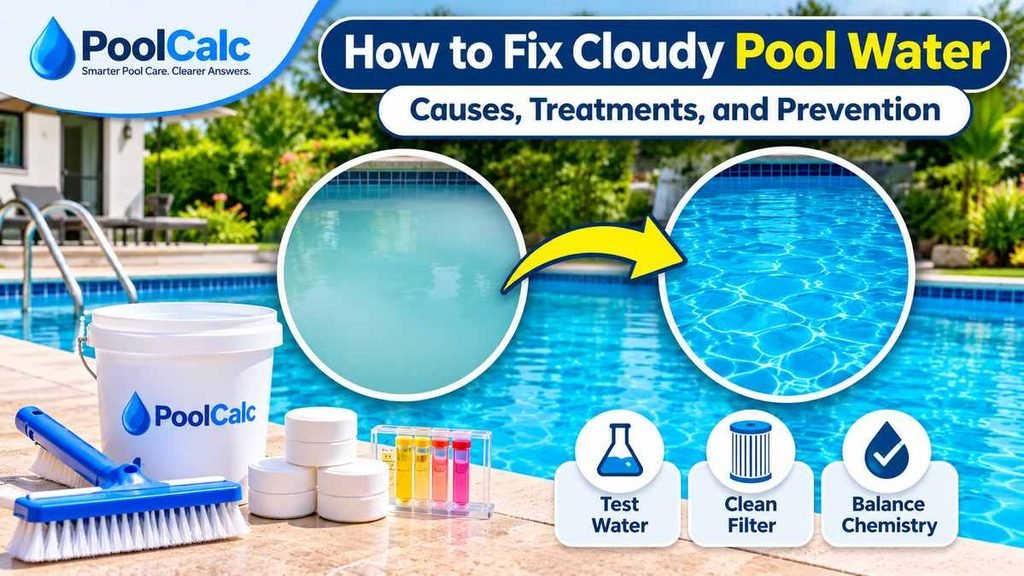
Clear pool water depends on balanced chemistry, effective filtration, and consistent maintenance. Swimming Pool Calculator provides useful pool calculation tools that can support routine water-care decisions.
Cloudy water occurs when tiny particles remain suspended instead of being removed by the filtration system. These particles may include dust, pollen, body oils, dead algae, and other contaminants. Chemical imbalance can also contribute to the problem.
A cloudy pool does not always mean that algae is present. The cause may be poor filtration, high calcium hardness, incorrect pH, or insufficient sanitizer. Identifying the source is more effective than adding several products without testing.
Start by checking your pool’s water capacity and filtration requirements. The pool volume calculator can help estimate the amount of water that needs treatment.
What Causes Cloudy Swimming Pool Water?
Poor Filtration
A dirty filter or inadequate circulation can allow fine particles to remain in the water. Check the pressure gauge and inspect the filter according to its manufacturer’s maintenance instructions.
Incorrect pH and Alkalinity
High pH can contribute to calcium scaling and cloudy water. Low or unstable alkalinity can also make pH difficult to control.
Low Chlorine Levels
When free chlorine is too low, contaminants and microorganisms may accumulate. This can cause cloudy or dull-looking water.
High Calcium Hardness
Excess calcium can form visible particles when water chemistry becomes unbalanced. This may create a milky appearance, especially when pH is also high.
Environmental Contamination
Rain, wind, pollen, dust, leaves, and heavy swimmer activity can introduce particles into pool water.
How to Fix Cloudy Pool Water
Step 1: Test the Water
Check free chlorine, pH, total alkalinity, and calcium hardness. Also test stabilizer levels when relevant. Compare the results with your pool product manufacturer’s recommended ranges.
Step 2: Clean the Pool
Remove leaves and debris using a skimmer. Brush the walls and floor to loosen dirt. Vacuum the pool if particles have settled.
Step 3: Inspect the Filter
Check whether the filter needs backwashing, rinsing, or cartridge cleaning. Do not backwash more frequently than necessary because this can waste water and may reduce filtration efficiency.
Step 4: Correct Chemical Imbalances
Adjust pH, alkalinity, and sanitizer levels based on test results. Follow product labels carefully. Add chemicals separately and allow adequate circulation between treatments.
Step 5: Consider a Pool Clarifier
A clarifier helps small suspended particles combine into larger particles that the filter can capture. It is not a substitute for proper filtration or balanced water chemistry.
Step 6: Run the Pump
Allow the filtration system to operate long enough to circulate and clean the water. Check the filter pressure and water clarity during the process.
Clarifier vs. Flocculant: What Is the Difference?
A pool clarifier helps the filter capture fine particles. A flocculant gathers particles into larger clumps that settle to the pool floor. These clumps usually need to be vacuumed to waste.
Not every filtration system is suitable for every flocculant. Check the product instructions before use.
How to Prevent Cloudy Pool Water
- Test water chemistry on a regular schedule.
- Maintain appropriate sanitizer levels.
- Keep the filter clean.
- Remove leaves and debris promptly.
- Brush and vacuum the pool regularly.
- Maintain suitable circulation.
- Monitor calcium hardness and total alkalinity.
Common Mistakes That Make Cloudiness Worse
Adding more chlorine without testing may not solve a filtration problem. Using too much clarifier can also create additional water-quality issues. Running a pump with a clogged filter will not deliver effective results.
Avoid swimming when visibility is poor enough that you cannot clearly see the pool floor or main drain. Cloudy water can hide hazards.
Frequently Asked Questions
Why is my pool cloudy but chlorine is normal?
Normal chlorine does not guarantee clear water. Filtration problems, high calcium hardness, and suspended particles can still cause cloudiness.
How long does it take to clear cloudy pool water?
It may take several hours or a few days. The result depends on the cause, filter condition, circulation, and water chemistry.
Can I swim in cloudy pool water?
It is safer to wait until the water is clear enough to see the pool floor and chemical levels are within the recommended range.
Does a pool clarifier remove algae?
A clarifier can help capture suspended particles, but it does not replace an appropriate algae treatment.
 kim.sehu
 norynis.ravinwyn
 jenn.diessi