
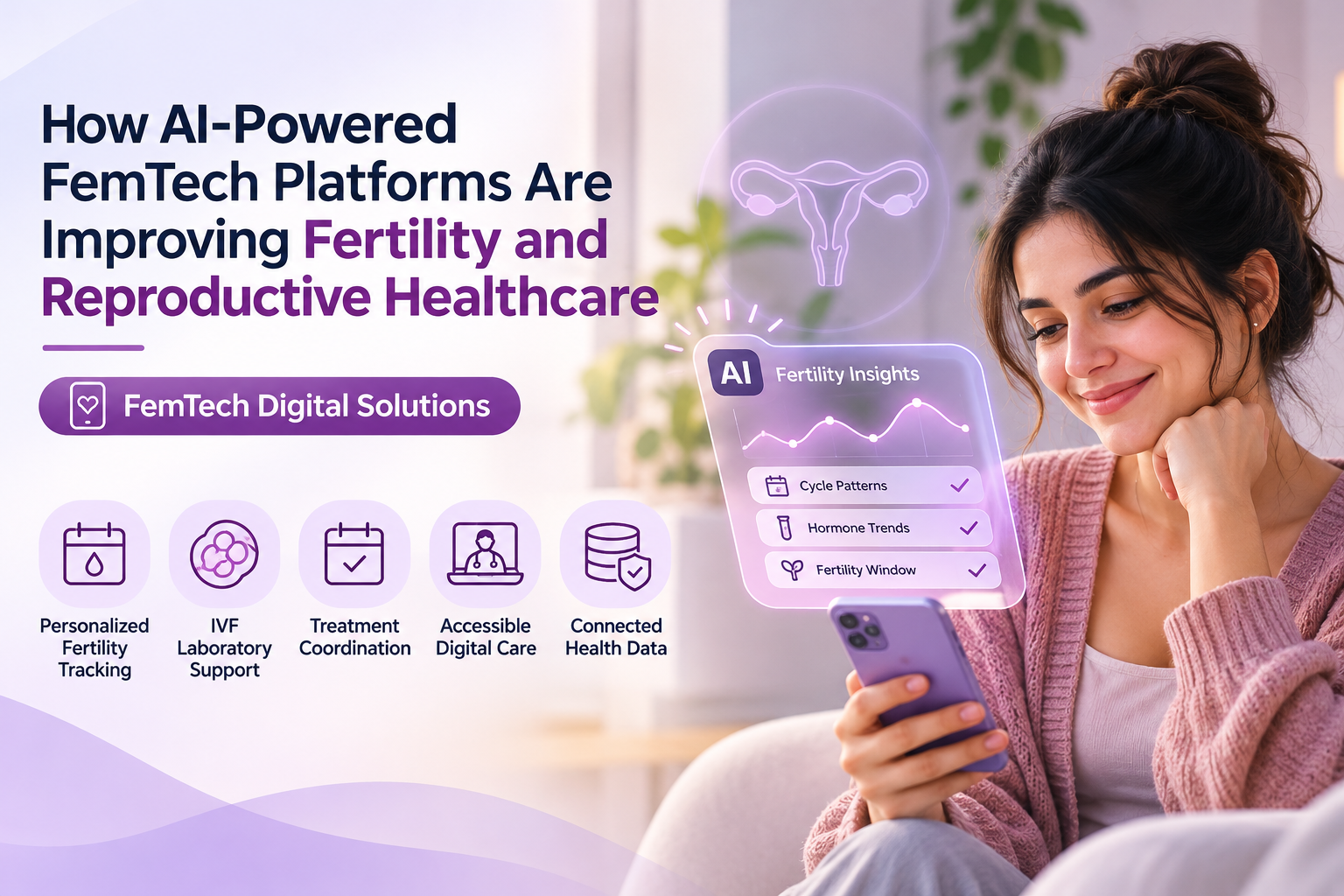
For someone undergoing fertility treatment, uncertainty often extends beyond medical results. There are appointments to coordinate, hormone levels to monitor, medications to manage, and difficult decisions to make. Meanwhile, healthcare providers must interpret complex clinical information while keeping patients informed and supported throughout treatment.
These challenges highlight an important opportunity for digital healthcare.
Artificial intelligence is creating new possibilities in fertility and reproductive medicine, from identifying patterns in health information to supporting IVF laboratory workflows and improving communication between patients and care teams.
As FemTech Digital Solutions evolve, their role is expanding beyond basic period tracking and wellness applications. Modern platforms can help connect reproductive health information, clinical workflows, and personalized patient support.
However, the real value of AI is not simply predicting outcomes. It lies in making reproductive healthcare more coordinated, accessible, and responsive without replacing clinical expertise.
Why Fertility and Reproductive Healthcare Need Smarter Digital Solutions
Infertility is a significant global healthcare challenge. According to the World Health Organization, approximately one in six people of reproductive age worldwide experience infertility during their lifetime.
Despite advances in assisted reproductive technology, patients and healthcare professionals continue to encounter fragmented information, treatment complexity, and limited access to specialized services.
Fertility care frequently involves multiple systems and professionals. Laboratory results may be stored separately from consultation records, medication instructions may arrive through different communication channels, and patients may struggle to understand their treatment progress.
These disconnected experiences can make an already demanding process more difficult.
AI-powered digital platforms offer ways to address some of these operational challenges by organizing relevant information, supporting repetitive tasks, and helping healthcare professionals identify patterns that deserve closer attention.
The goal is not to remove the human element from reproductive medicine. It is to give clinicians better tools and patients clearer information.
How AI Is Changing Fertility and Reproductive Healthcare
1. Making Fertility Tracking More Personalized
Traditional fertility tracking applications commonly rely on calendar-based estimates and user-entered menstrual cycle information.
However, reproductive health patterns vary considerably between individuals. Menstrual cycles may be irregular, symptoms can fluctuate, and conditions such as polycystic ovary syndrome (PCOS) can make calendar-based predictions less reliable.
AI-enabled platforms can analyze multiple types of information, including cycle history, symptoms, basal body temperature, and compatible wearable data.
By identifying trends over time, these systems may help users understand their reproductive health patterns and recognize when a professional assessment could be useful.
For example, an application might highlight recurring cycle irregularities rather than relying only on a predicted ovulation date.
Importantly, AI-generated fertility predictions are estimates, not medical diagnoses or guarantees of conception. Their accuracy depends on data quality, the population used to develop the model, and whether the technology has been clinically validated.
2. Supporting IVF Laboratory Workflows and Embryo Assessment
In vitro fertilization (IVF) involves several carefully coordinated laboratory and clinical procedures.
Embryologists examine developing embryos using established assessment methods to help determine which embryos may be suitable for transfer or preservation.
AI-based image analysis is being investigated as a way to support this process.
Machine learning models can examine embryo images and time-lapse imaging data to identify developmental characteristics and generate standardized assessments.
This approach may offer practical advantages by reducing the time required for certain evaluation tasks and improving consistency in laboratory workflows.
However, greater efficiency does not automatically mean higher pregnancy or live-birth rates.
A 2026 committee opinion from the American Society for Reproductive Medicine emphasizes that stronger prospective evidence is needed before claims about improved clinical outcomes can be established.
AI should therefore be viewed as a tool that can assist embryologists, not independently determine embryo selection or replace professional judgment.
3. Improving Fertility Treatment Coordination
Fertility treatment is rarely a single appointment or intervention.
Patients undergoing assisted reproductive treatment may require repeated consultations, diagnostic testing, medication adjustments, ultrasound monitoring, and laboratory procedures.
Managing these activities across disconnected systems creates administrative work for clinical teams and potential confusion for patients.
AI-enabled workflows can support treatment coordination by organizing schedules, identifying incomplete documentation, and helping staff prioritize follow-up activities.
For instance, a fertility clinic could use a connected platform to identify patients whose laboratory results have arrived but whose follow-up appointments have not yet been scheduled.
Automated reminders can also help patients keep track of appointments and clinician-prescribed medication schedules.
These improvements may reduce communication gaps and routine administrative effort. Their effectiveness should be measured through actual workflow results rather than assumed from the presence of AI features.
4. Making Reproductive Healthcare More Accessible Through Digital Care
Access to fertility specialists remains uneven, especially for people who live far from specialist clinics or face transportation, financial, and scheduling barriers.
Digital reproductive healthcare platforms can support remote consultations, secure communication, educational resources, and follow-up coordination.
When combined with carefully governed AI capabilities, these platforms can help organize patient questions, direct administrative requests, and surface relevant information for clinicians.
Consider someone beginning a fertility assessment while living several hours away from a specialist clinic.
A connected digital platform could allow that person to review instructions, access approved educational materials, share relevant records, and attend suitable follow-up consultations remotely.
This does not eliminate the need for physical examinations, laboratory testing, or procedures that require an in-person visit.
Instead, it can make the parts of care that are suitable for remote delivery easier to manage.
5. Connecting Reproductive Health Data Across Systems
One of the biggest challenges in digital reproductive healthcare is not a lack of information. It is the difficulty of bringing that information together meaningfully.
A patient’s reproductive health journey may involve electronic health records, laboratory systems, diagnostic platforms, wearable devices, and mobile applications.
When these systems cannot exchange information effectively, healthcare professionals may need to manually retrieve records or work with incomplete patient histories.
This is where interoperability becomes essential.
Modern FemTech Digital Solutions can use healthcare integration standards such as HL7 and FHIR, where appropriate, to support structured information exchange between compatible clinical systems.
For example, a fertility care platform could bring authorized laboratory results, appointment information, and relevant clinical documentation into a coordinated workflow.
With suitable clinical oversight, AI could then help organize this information or flag missing records for review.
The benefit is a more connected care experience, not simply a larger collection of data.
What Healthcare Organizations Should Consider Before Implementing AI-Powered FemTech Platforms
Although AI presents valuable opportunities, reproductive healthcare involves highly sensitive personal information and decisions with significant emotional and medical consequences.
Successful implementation requires more than selecting a machine learning model.
Clinical validation and reliability
AI models should be evaluated against the specific task they are designed to perform. A system that predicts menstrual cycle patterns requires different evidence from one used to assist with embryo assessment.
Healthcare organizations should examine clinical validation, performance across relevant patient populations, and the consequences of incorrect predictions.
Privacy and data protection
Fertility records, menstrual histories, pregnancy information, and reproductive treatment details require strong privacy protections.
Platforms should incorporate appropriate encryption, access controls, consent management, data minimization, and clear retention policies.
In the United States, applicable privacy and breach notification requirements depend on the organization’s role and the data it handles. Certain consumer health applications may fall under the Federal Trade Commission’s Health Breach Notification Rule, even when HIPAA does not apply.
Human oversight and transparency
Healthcare professionals must remain responsible for clinical interpretation and treatment decisions.
AI-generated recommendations should be understandable enough for clinicians to review their relevance, limitations, and potential risks.
Patients should also know when AI is involved in their care and understand the difference between informational guidance and medical advice.
Integration with existing healthcare systems
A standalone application may create more work if staff must repeatedly transfer information between platforms.
Healthcare providers should assess whether a new solution can integrate securely with their existing electronic health records, laboratory systems, patient portals, and operational workflows.
Measurable outcomes
The success of an AI-powered platform should be evaluated against specific objectives.
These may include reduced administrative workload, faster document processing, improved appointment coordination, greater continuity of patient communication, or more consistent laboratory assessments.
Clinical outcome improvements should only be claimed when supported by appropriate evidence.
The Future of AI-Powered FemTech Digital Solutions
The next stage of FemTech innovation will likely depend less on adding isolated AI features and more on connecting digital tools throughout the reproductive healthcare journey.
A person might begin by recording menstrual health information, later consult a specialist through a digital care platform, and eventually receive treatment supported by integrated laboratory and clinical systems.
When these services exchange relevant information securely, healthcare providers can gain better continuity across different stages of care.
AI may also support future advances in reproductive health research, treatment planning, patient education, and laboratory operations.
Yet progress will depend on addressing persistent challenges, including data quality, algorithmic bias, patient privacy, clinical evidence, and unequal access to technology.
The strongest platforms will be those that demonstrate practical benefits while respecting the complexity and individuality of reproductive healthcare.
Conclusion
AI-powered FemTech platforms are opening new possibilities for fertility and reproductive healthcare.
From more personalized cycle insights to IVF laboratory support, treatment coordination, and interoperable patient records, these technologies can help address challenges that affect both patients and healthcare providers.
However, innovation should not be confused with proven clinical effectiveness. AI can improve certain workflows and support better-informed decisions, but claims about higher pregnancy success rates require rigorous validation.
The future of reproductive healthcare will depend on combining responsible AI, connected healthcare systems, strong data protection, and continued clinical expertise.
For fertility clinics, healthcare organizations, and digital health innovators, the priority should be developing technology that solves real patient and operational problems.
Ultimately, the success of FemTech will be measured not by how much it automates, but by how effectively it supports safe, accessible, and patient-centered reproductive care.
 sensepc.game
 zafarlaser.eyeclinic