
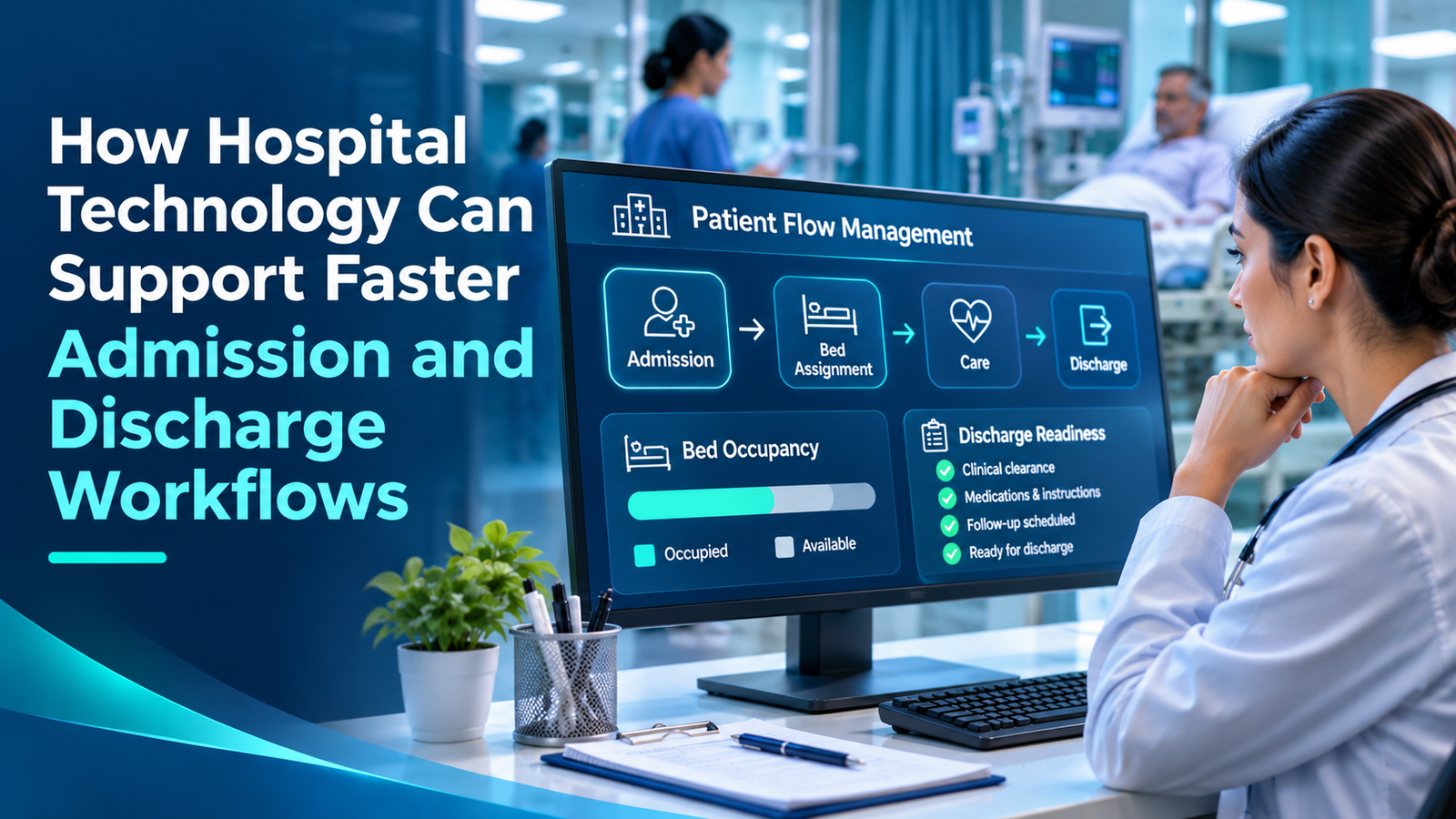
A patient arrives at the emergency department and completes the initial assessment. The doctor decides that hospital admission is necessary, but the patient cannot move to an inpatient ward because an appropriate bed is not yet available. Meanwhile, another patient has been medically cleared for discharge but is still waiting for medication instructions and final documentation.
Both situations create delays, even though the clinical decisions have already been made.
For hospitals, admission and discharge are not isolated administrative activities. They involve several departments, applications, and healthcare professionals working together. When information moves slowly between these teams, patient flow becomes difficult to manage.
Hospital technology can help address these challenges by connecting clinical systems, improving task visibility, and reducing unnecessary manual coordination. The objective is not to rush patient care but to remove avoidable delays while maintaining appropriate clinical oversight.
Why Hospital Admission and Discharge Workflows Face Delays
A hospital admission involves much more than registering a patient. Staff may need to confirm identity, review clinical information, complete administrative requirements, arrange a suitable bed, and coordinate the transfer between departments.
Discharge involves similar coordination. Physicians must confirm clinical readiness, nurses prepare patient instructions, pharmacy teams review medications, and care coordinators arrange follow-up services.
When these activities depend on separate systems and manual communication, small delays can affect the entire workflow.
For example, an available bed may not appear in the bed management system until someone manually updates its status. The admission team may continue searching for space even though a room is being prepared.
Similarly, a discharge order may be entered, but the pharmacy or care coordination team may not immediately receive the information required to complete its work.
Common challenges include:
- Disconnected hospital systems: Patient information does not move consistently between EHR, admission, bed management, and departmental applications.
- Manual status updates: Teams depend on phone calls, spreadsheets, or repeated follow-ups to track patient movement.
- Incomplete documentation: Missing records or pending approvals interrupt admissions and discharge preparation.
- Limited bed visibility: Staff cannot easily distinguish occupied, available, reserved, and cleaning-pending beds.
- Poor task coordination: Departments may not know which activities remain incomplete or who is responsible.
Addressing these problems requires hospitals to improve how information and responsibilities move throughout the patient journey.
How Hospital Technology Can Improve Admission Workflows
Technology can support smoother admissions when it connects patient information, clinical decisions, and operational activities.
1. Simplifying Patient Registration and Intake
Patient registration often requires staff to collect demographic information, verify existing records, and complete administrative forms.
Digital intake systems can reduce repetitive information entry by allowing authorized teams to access and reuse information already available within connected hospital applications.
For returning patients, relevant details may be retrieved from existing records, subject to verification.
This can reduce duplicate work and help administrative teams complete registration more consistently.
However, digital intake should still include procedures for confirming patient identity, correcting inaccurate information, and handling incomplete records.
2. Connecting Emergency Departments With Admission Teams
Once a physician decides that a patient requires inpatient admission, several operational steps begin.
The admission team needs information about the patient’s required level of care, bed requirements, and transfer status.
If this information is communicated manually, staff may spend time calling departments or checking multiple applications.
Connected hospital systems can use admission, discharge, and transfer (ADT) events to share relevant status changes with authorized teams.
For example, an approved admission request can trigger a task for bed allocation while updating the appropriate operational worklist.
This helps staff see what needs attention without relying entirely on individual phone calls.
3. Improving Bed Availability and Allocation
Bed availability is an important factor in hospital admission delays.
A physical bed may exist, but it cannot be assigned until the previous patient has left, cleaning is completed, and staffing and clinical requirements are satisfied.
Digital bed management platforms can bring these statuses into a shared operational view.
Admission teams may then identify suitable beds based on availability, care requirements, and relevant capacity constraints.
Better visibility can reduce unnecessary coordination and help departments prepare for incoming patients.
Technology does not create additional staffed beds, but it can help hospitals use available resources more efficiently.
How Technology Supports Faster Discharge Workflows
Discharge delays can affect both patient experience and hospital capacity.
Even after a physician determines that a patient is medically ready to leave, several activities may remain incomplete.
A connected discharge workflow can make these dependencies easier to manage.
1. Starting Discharge Planning Earlier
Discharge preparation should not always begin when the final discharge order is entered.
Hospitals can use structured workflows to identify likely discharge requirements earlier during a patient’s stay.
For example, care coordinators may need to arrange medical equipment, transportation, home care services, or follow-up appointments.
Digital task management systems can help teams identify pending requirements and monitor their completion.
Earlier visibility may prevent avoidable last-minute delays without changing clinical discharge criteria.
2. Coordinating Documentation and Medication Tasks
Discharge documentation often requires information from physicians, nurses, pharmacists, and other care professionals.
When these tasks are handled across disconnected applications, staff may struggle to understand which steps are complete.
Integrated systems can provide shared task statuses and notify appropriate teams when action is required.
For instance, a signed discharge order may initiate a pharmacy review task or notify a care coordinator that discharge planning can proceed.
Medication reconciliation, patient education, and final clinical approvals must remain part of the established safety process.
The purpose of automation is to improve coordination, not bypass important checks.
3. Improving Patient Instructions and Follow-Up Coordination
Patients need clear information about medications, appointments, and care arrangements before leaving the hospital.
Discharge platforms can support the preparation of patient-friendly instructions and organize follow-up activities.
Where integrated with scheduling and clinical systems, they may also help staff identify confirmed appointments and outstanding arrangements.
This can reduce repeated administrative work and improve the consistency of discharge communication.
Healthcare professionals must still verify that instructions are accurate and that patients understand the next steps in their care.
Why Hospital System Integration Matters
A hospital may already have an EHR, a bed management platform, a pharmacy application, and a scheduling system.
Introducing another application will not automatically improve patient flow if these existing systems cannot communicate.
Integration allows relevant information to move between applications without requiring staff to repeatedly copy or re-enter details.
HL7 messaging, FHIR-based interfaces, APIs, and integration platforms can support different types of healthcare information exchange.
For example, when a patient is discharged, connected applications may receive appropriate status updates, allowing downstream teams to begin room preparation or complete administrative activities.
Successful integration also requires accurate patient matching, reliable timestamps, appropriate access permissions, and clear procedures for handling failed messages.
Without these safeguards, automated updates can create confusion instead of reducing it.
Creating Better Visibility Across Hospital Operations
Hospital leaders need to understand where patients are waiting and why.
Operational dashboards can combine information from admission, discharge, transfer, and capacity management systems to provide a clearer view of workflow performance.
Rather than showing only the number of occupied beds, these dashboards can identify pending transfers, discharge tasks, cleaning status, and unresolved operational issues.
Useful measures include admission decision-to-bed placement time, discharge order-to-departure time, bed turnaround time, and the volume of patients waiting for inpatient placement.
Hospitals can use these measures to identify recurring bottlenecks and decide where process improvements or technology changes are needed.
The value comes from making operational problems visible enough for teams to address them.
What Hospitals Should Modernize First
Hospitals do not need to replace every existing application to improve admission and discharge workflows.
A practical starting point is reviewing how patient status information moves between departments.
Leaders should identify where staff repeatedly enter information, wait for approvals, or contact other teams for updates.
They can then prioritize improvements based on operational impact and implementation effort.
Some hospitals may benefit from connecting existing applications. Others may need improved user interfaces, automated task routing, or modernization of older systems.
A limited pilot focused on one admission or discharge bottleneck can help determine whether the changes reduce manual effort and waiting time.
Clinical safety, staff feedback, data accuracy, and system reliability should remain part of the evaluation.
How Ditstek Innovations Supports Hospital Admission and Discharge Modernization
Improving hospital workflows requires more than implementing digital forms or standalone automation tools.
Ditstek Innovations helps hospitals, health systems, and healthcare technology companies improve clinical and operational workflows through system integration, application modernization, platform engineering, and process automation.
Its services support several areas of hospital operations.
Hospital System Integration
Ditstek Innovations supports connectivity between EHR systems, ADT platforms, bed management applications, laboratory systems, and other hospital technologies using appropriate interoperability approaches.
Patient Flow and Workflow Automation
The company helps healthcare organizations develop connected workflow solutions for patient intake, admissions, transfers, task coordination, and discharge activities.
Legacy Healthcare Software Modernization
Ditstek Innovations supports the modernization of older hospital applications through API enablement, architecture improvements, and application engineering.
This can help healthcare organizations improve system connectivity without unnecessarily replacing existing technology investments.
Hospital Operations Platforms
The company supports the engineering of operational dashboards, shared worklists, and workflow coordination platforms that improve visibility into patient movement, capacity constraints, and pending tasks.
Its consulting-led approach focuses on understanding hospital processes and technology limitations before recommending implementation priorities.
Conclusion
Faster admission and discharge workflows depend on more than completing forms quickly. Hospitals need accurate information, coordinated teams, reliable system connections, and visibility into unfinished tasks.
Technology can help reduce manual handoffs, improve bed management, and make discharge activities easier to coordinate.
However, meaningful improvements begin with understanding where existing workflows slow down and why.
Hospitals that combine thoughtful process redesign with system integration and targeted modernization can work toward smoother patient transitions while maintaining clinical safeguards.
Healthcare organizations looking to strengthen patient flow, improve hospital operations, and connect critical systems can explore Ditstek Innovations’ acute care IT services to support their modernization requirements.
 max.leo
 edward.leywin