
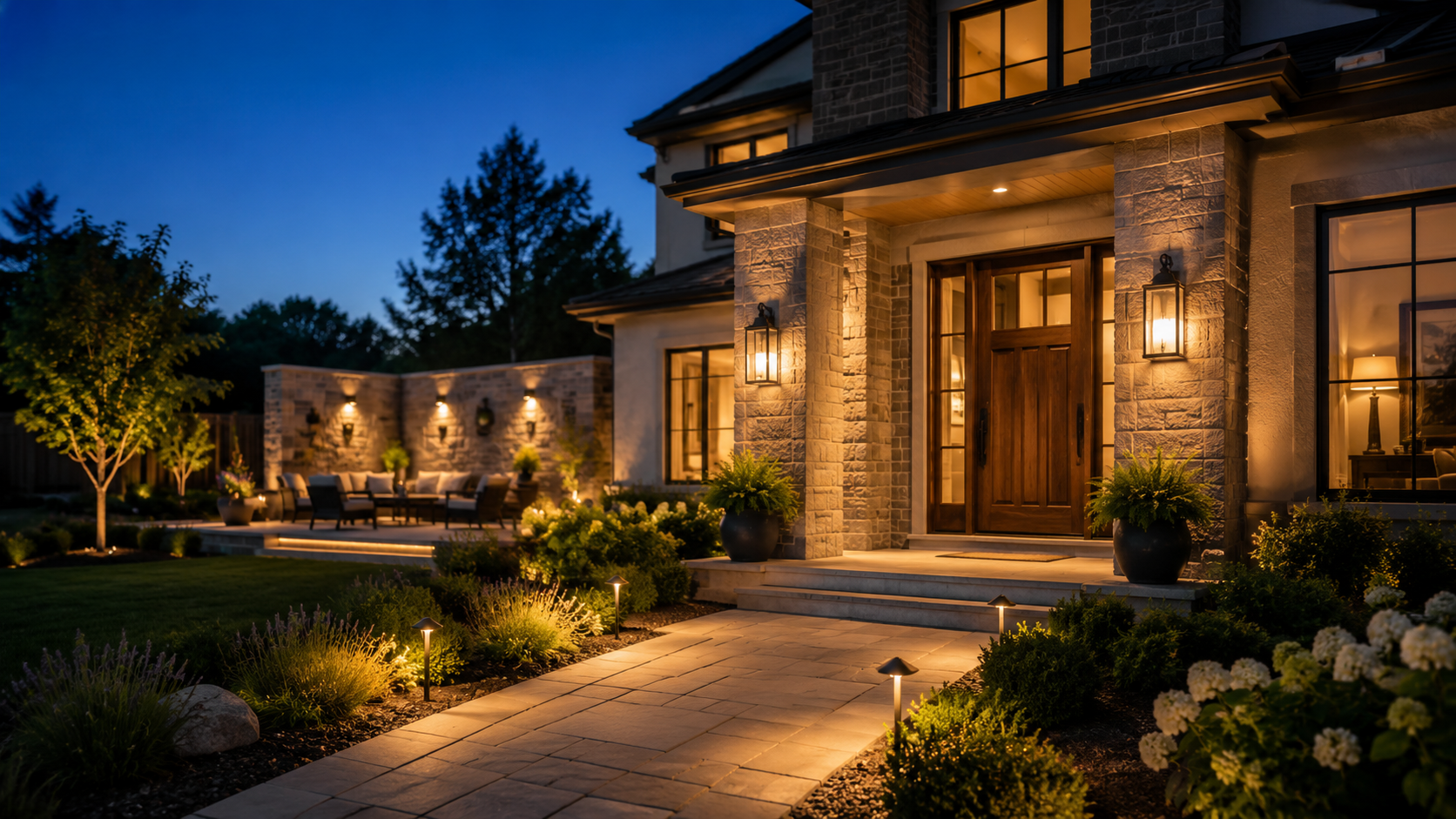
Most people walk past the same outdoor fixtures every day without noticing they’re working half as well as they should. A burned bulb here, a dirty lens there, a timer that stopped syncing months ago. These small lapses don’t announce themselves, but they quietly undermine how your home presents itself from the street, how safely your family moves around after dark, and how much you’re spending on fixtures that aren’t pulling their weight. What if you could catch all of it in five minutes? You can. This isn’t about a deep retrofit or calling an electrician. It’s about knowing exactly where to look, what matters, and what you can fix right now. If you’ve been putting off an outdoor lighting review because it sounds like a project, this is the version that actually fits into a weekday evening. Let’s walk through it, one zone at a time, so your exterior lighting works the way it’s supposed to.
What Your Entry Lighting Says Before Anyone Knocks
Your front door is the first place people look when they arrive after sunset. If the lighting there feels dim, uneven, or nonexistent, that impression sticks. Walk up to your entry as if you’re a guest arriving for the first time. Is the house number visible from the curb? Can you see the door handle clearly without fumbling? A quality outdoor porch light positioned near the entrance should cast enough light to define the door, the step, and the immediate surround without creating harsh shadows across faces. According to the Illuminating Engineering Society, entry lighting should deliver at least 10 to 20 foot candles at the doorstep for safe navigation and security visibility. If your fixture has been there for years and you’ve never swapped the bulb, check the wattage and color temperature. Many older installations run cool white LEDs that feel clinical rather than welcoming. Swapping to a warmer 2700K to 3000K bulb takes two minutes and changes the entire mood of your entrance. One more thing to check: is the fixture itself clean? Dust, pollen, and insect debris can cut light output by 30 percent or more, turning what should be a well-lit entry into something that barely registers.
The Spots You Walk Past Every Night Without Seeing
Most homes have a handful of exterior lights that get ignored because they’re not front and center. Side doors, garage entries, back steps. These zones matter more than you’d think, especially for daily family use. If you’re carrying groceries in the dark or letting the dog out before bed, those transitions need light that actually works. Walk your property perimeter at dusk and note any area where you pause, squint, or slow down. That’s your cue. Fixtures in high traffic zones should be checked every season, not just when they burn out. A motion sensor that no longer triggers, a photocell that stays on all day, or a bulb that flickers when it’s cold are all signs of a fixture that needs a refresh. Replacing a faulty sensor costs less than running a light 24/7 for six months because you didn’t catch the malfunction.
Accent and Landscape Lighting That Stopped Doing Its Job
If you installed path lights, uplights, or garden spots a few years ago, there’s a decent chance half of them aren’t working the way they used to. Buried wiring gets nicked by shovels, transformers fail quietly, and low-voltage bulbs dim over time without burning out completely. This is where the five-minute check pays off. Walk your landscape lighting circuit at night and look for dark spots, tilted fixtures, or lights that are noticeably dimmer than their neighbors. A simple voltage test can tell you if your transformer is undersized or if corrosion has built up at the connections. According to a 2025 survey by the American Lighting Association, nearly 40 percent of homeowners reported that their landscape lighting systems underperformed due to poor maintenance, not poor design. If your path lights are spaced more than 10 feet apart, you’re creating gaps that feel unsafe and visually disconnected. Tightening that spacing or adding one or two strategically placed patio lights along a walkway or near an outdoor seating area can bring the whole layout back into balance. The goal isn’t to flood the yard with light but to create continuity so your eye knows where to go.
How Your Lighting Timer Might Be Costing You More Than It Should
Timers and smart controls are supposed to make outdoor lighting easier, but they only work if they’re set correctly. If your lights are coming on at 6 p.m. in May when sunset isn’t until 8:30, you’re wasting electricity and bulb life for no reason. Most modern photocell sensors and smart switches can self-adjust based on local sunrise and sunset times, but older mechanical timers require manual updates every few months. Check your control settings tonight. If you’re running on a schedule that hasn’t been touched since last fall, it’s probably off by an hour or more. The Department of Energy notes that outdoor lighting accounts for roughly 10 percent of a home’s total energy use when left on longer than necessary. Adjusting your timer to match the actual season can shave 20 to 30 dollars off your annual electric bill without changing a single fixture. If your system doesn’t have a dusk-to-dawn sensor, upgrading to one costs around 15 to 25 dollars and removes the guesswork entirely.
When a Quick Fix Becomes a Smart Upgrade
There’s a difference between maintaining what you have and recognizing when a fixture has outlived its usefulness. If you’re constantly replacing bulbs in the same spot, or if a fixture looks dated compared to the rest of your exterior, this is the moment to consider a swap rather than another band-aid repair. Upgrading to an LED integrated fixture eliminates the bulb replacement cycle for up to 25,000 hours, which translates to nearly a decade of typical use. Coastal homes or properties near heavy foliage should prioritize fixtures with sealed housings and corrosion-resistant finishes. Brass, powder-coated aluminum, and stainless steel hold up far better than basic painted steel, which can rust through in three to five years, depending on exposure. If you’re replacing one fixture anyway, take the opportunity to check whether the mounting hardware is still secure, the wiring is properly sealed, and the electrical box isn’t loose or corroded. Small issues caught early don’t escalate into expensive repairs later.
The Real World Test Every Homeowner Should Run Tonight
Here’s the simplest version of the five minute check. Grab your phone, step outside at dusk, and take a photo of your home from the street. Look at the image. Does your house feel defined, welcoming, and intentional, or does it fade into the background? Next, walk your front path, side entries, and backyard as if you’re moving through the space for the first time. Are there any spots where you hesitate, reach for a phone flashlight, or feel uncertain about your footing? Those are your priority fixes. Finally, flip every outdoor switch and see what actually lights up. Note anything that doesn’t respond, flickers, or looks noticeably dimmer than the others. That’s your action list. Most of what you’ll find can be addressed in a single afternoon with basic tools and a trip to the hardware store. If something looks like it needs an electrician, don’t guess. Outdoor wiring and fixture installation come with moisture and safety concerns that aren’t worth the risk of a DIY mistake.
How to Keep This Check From Becoming a Chore
Once you’ve done a full circuit of your outdoor lighting, maintaining it becomes second nature. Set a seasonal reminder on your phone for spring and fall to repeat the same five minute walk. Clean fixture lenses with a damp cloth every few months. Swap out bulbs before they burn out completely if you’re using non-LED fixtures. Tighten any loose mounting screws before they vibrate free. Check motion sensors and photocells annually to make sure they’re still responsive. A well maintained outdoor lighting system doesn’t just look better, it extends the life of your fixtures by years and keeps your property safer and more functional for everyone who uses it. Small attention now saves you from expensive replacements later, and it means your home always feels put together, even when no one’s watching.
FAQ
How often should I replace outdoor light bulbs?
LED bulbs last 15,000 to 25,000 hours, so most homeowners replace them every 7 to 10 years. Incandescent or halogen bulbs need replacement every 1 to 2 years, depending on usage.
What’s the best way to clean outdoor light fixtures?
Turn off the power at the breaker first. Remove the fixture cover and wipe down the interior and lens with a damp microfiber cloth. Avoid harsh chemicals that can damage protective coatings. For metal fixtures, check for rust or corrosion and apply a thin coat of clear sealant if needed. Cleaning twice a year, in spring and fall, prevents buildup that reduces light output and makes your fixtures look neglected.
Do outdoor lights need to be on all night?
Not unless you have a specific security or visibility concern. Motion-activated lights or dusk-to-dawn sensors with timers offer better efficiency. Most experts recommend lighting high-traffic entry points continuously and using motion detection for secondary zones like side yards or garages.
 CEO Asif
[…] form their initial opinion of your home before they even step through the front door. Improving curb appeal is consistently one of the highest-return investments you can make. Simple […]