
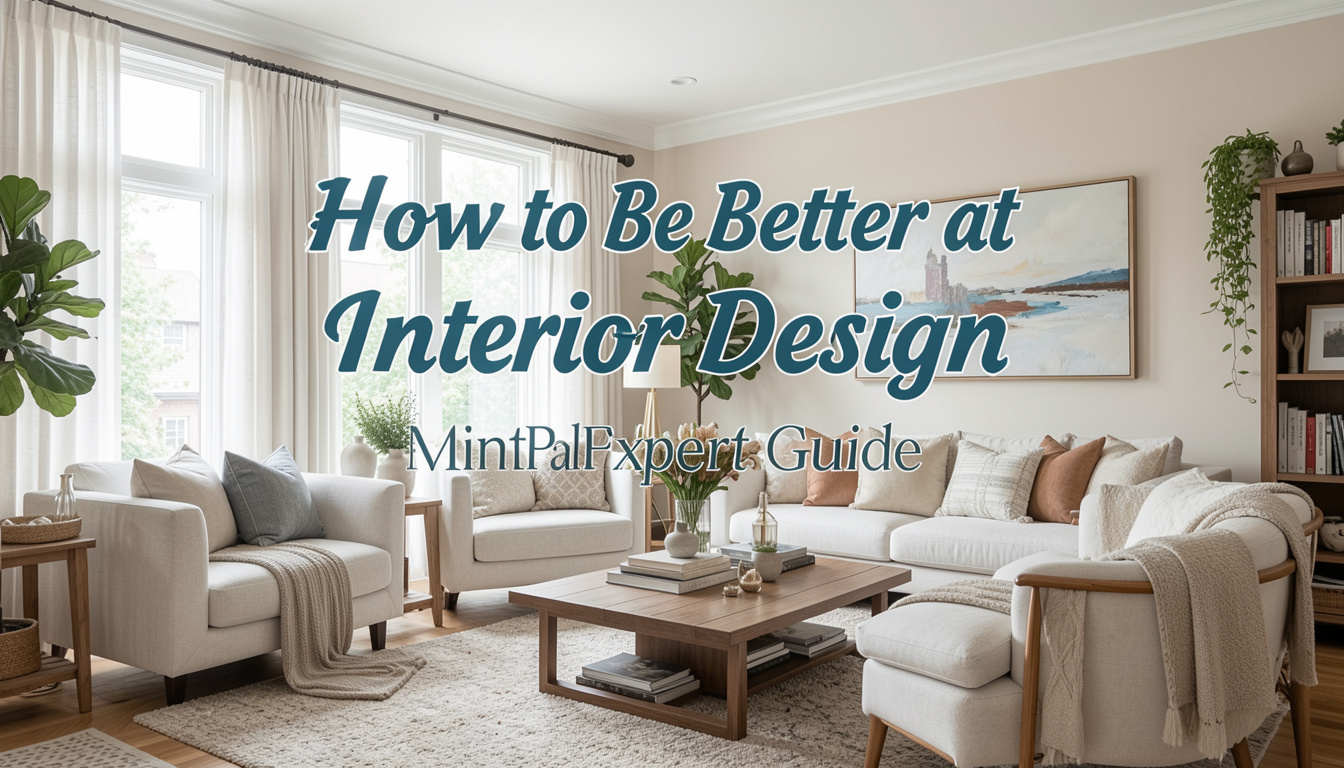
Interior design isn’t just about making a space look nice it’s about creating an environment that reflects who lives there, works with how they actually move through the room, and genuinely improves day-to-day life. Whether you want to redecorate your own home or build real professional skill, learning how to be better at interior design takes time, practice, and a willingness to learn from what doesn’t work.
![A designer sketching a floor plan alongside fabric swatches]](http://decorluxuryhome.com/wp-content/uploads/2026/06/A-designer-sketching-a-floor-plan-alongside-fabric-swatches-1024x585.jpeg)
At MintPalDecor, we believe good design is achievable for everyone not just those who hire a professional. Here’s a practical guide to improving your interior design skills, one principle at a time.
Start With the Fundamentals
Before trends and styling, you need the seven core principles that every strong design rests on: balance, rhythm, emphasis, proportion, scale, harmony, and unity.
- Balance distribute visual weight across a room. Symmetrical balance repeats elements on either side of a center point; asymmetrical balance pairs different objects with similar visual weight.
- Rhythm repeating elements, colors, or textures creates a sense of motion through the space.
- Emphasis every room needs one focal point: a statement wall, a fireplace, or a standout piece of furniture.
- Proportion and scale how objects relate to each other and to the room itself. An oversized sectional overwhelms a small apartment; tiny furniture gets lost in a large room.

Understanding these relationships early helps you avoid the most common design mistakes before you spend a cent.
Master Color Theory and Palettes
Color changes a room instantly, and a little color theory goes a long way. Learn the basics of the color wheel: complementary colors (opposite each other), analogous colors (next to each other), and triadic schemes (three colors spaced evenly) each gives you a reliable way to build a palette.
Warm colors like reds, oranges, and yellows energize a space and work well in living rooms and dining areas. Cool colors like blues, greens, and purples calm a room down, which is why they suit bathrooms and bedrooms. Neutrals white, gray, beige, black give you a flexible base for brighter accents.
![Color wheel next to a styled room showing a 60-30-10 palette in action]](http://decorluxuryhome.com/wp-content/uploads/2026/02/Color-wheel-diagram-alongside-a-room-showcasing-the-60-30-10-color-rule-in-action-1024x585.jpeg)
A simple formula to apply immediately: the 60-30-10 rule. Your dominant color covers about 60% of the room (walls), a secondary color covers 30% (upholstery, curtains), and an accent color fills the remaining 10% (pillows, art, accessories). This ratio consistently produces rooms that feel polished rather than accidental.
Build Real Space Planning Skills
Space planning determines whether a room actually functions. Measure everything room dimensions, doorway widths, window placements before you buy anything, and sketch your layout on paper or a free planning tool first.
Traffic flow deserves real attention. Leave at least 30–36 inches for walkways so people can pass each other and furniture comfortably. In living rooms, keep seating 8–10 feet apart to encourage conversation. In dining rooms, leave 36–48 inches between the table edge and the wall so chairs can slide out freely.

Resist the instinct to push every piece against the wall. Floating furniture toward the center of a room encourages conversation and often makes the space feel larger, not smaller. In open-plan rooms, use an area rug to define a living or dining zone without needing an actual wall.
Study Real Design Resources
What separates strong designers from the rest is a habit of continuous learning. Follow interior design blogs, browse magazines like Architectural Digest or Elle Decor, and build inspiration boards through Pinterest, Instagram, or Houzz.

Visit furniture showrooms, design expos, and open houses to see professional staging firsthand. Pay attention to what draws your eye, and ask yourself why a particular pairing works. Build separate mood boards for different styles modern, traditional, bohemian, industrial — so you understand what defines each one.
Practice on Real Projects
Theory only goes so far without practice. Start with a single room rather than an entire home bedrooms make a great first project since they’re personal, manageable in scope, and low-stakes if something doesn’t work.
Set a realistic budget and timeline before you begin. Secondhand shopping, small DIY projects, and refinishing existing furniture with new paint or hardware all stretch a limited budget further. Estate sales, thrift shops, and online marketplaces are reliable sources for affordable finds.
![Before-and-after photos of a small bedroom makeover]](http://decorluxuryhome.com/wp-content/uploads/2026/06/Before-and-after-photos-of-a-small-bedroom-makeover-1024x585.jpeg)
Document each project with photos as you go. This builds a portfolio over time and helps you see clearly what worked and what didn’t — every designer learns as much from a misstep as from a success.
Develop Your Own Style
Principles and techniques matter, but they only take you so far the most memorable spaces reflect a genuine point of view. Once you’re comfortable with the basics, start mixing styles with intention: the most compelling rooms often blend contemporary furniture with vintage or retro accents.
![Eclectic living room mixing modern furniture with vintage accents]](http://decorluxuryhome.com/wp-content/uploads/2026/06/Eclectic-living-room-mixing-modern-furniture-with-vintage-accents-1024x585.jpeg)
Trust your instincts. If a piece speaks to you, find a way to work it into the room with purpose rather than dismissing it because it doesn’t match a trend. Your home should reflect you, not a magazine spread and it’s the personal touches that make a space feel lived-in rather than staged.
Layer in contrasting textures deliberately: pair smooth leather with a nubby linen throw, mix shiny metals with raw wood, or set plush velvet against crisp cotton. These contrasts add depth that a flat, single-texture room can’t achieve.
Keep Improving
Interior design keeps evolving — new materials, smart-home technology, and sustainability practices emerge constantly. Stay current by attending workshops, taking online courses, or joining a community of designers to trade ideas and feedback.
![Person attending a design workshop or browsing an online course]](http://decorluxuryhome.com/wp-content/uploads/2026/06/Person-attending-a-design-workshop-or-browsing-an-online-course-1024x585.jpeg)
Improving at interior design is an ongoing process, not a destination. Every project successful or not teaches you something. Treat early mistakes as part of the process, and give yourself credit for the small wins along the way.
Conclusion: Putting It All Together
How to Be Better at Interior Design MintPalDecor comes down to a few consistent habits: learn the fundamentals, understand color theory, build real space-planning skills, and develop a style that’s genuinely your own. Start with small projects, invest in a few quality pieces rather than many cheap ones, and don’t let the fear of a mistake stop you from starting mistakes are where most of the real learning happens.
At MintPalDecor, we’re committed to helping you build spaces you actually love living in. Put these principles into practice consistently, and the improvement in your design skills will show.
Frequently Asked Questions