
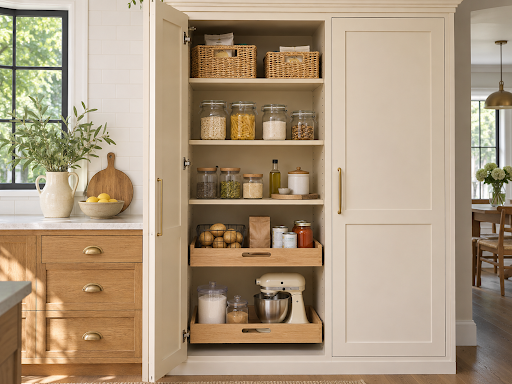
Kitchen storage affects how easily a household can prepare meals, organize supplies, and keep countertops clear. While base and wall cabinets handle many everyday items, pantry cabinets can provide dedicated space for groceries, small appliances, containers, and other kitchen essentials.
A well-planned pantry is not simply a tall cabinet with shelves. Its size, depth, layout, shelving, accessibility, and location all affect how useful it becomes. Homeowners should think about what they store, how often they use it, and how much space is available before choosing a pantry configuration.
For homeowners planning a kitchen remodel in Columbus, Ohio, understanding the different ways pantry cabinets can be designed can make it easier to create storage that supports everyday routines while fitting naturally into the overall kitchen.
What Are Pantry Cabinets and Why Are They Useful?
Kitchen pantry cabinets provide dedicated storage for food, kitchen supplies, and other items that may otherwise occupy several different cabinets. A pantry can help group similar products together, making it easier to see what is available and find items when they are needed.
Unlike scattered storage, a dedicated pantry can create a central location for dry goods, canned products, baking supplies, snacks, containers, and other household essentials. This can also reduce countertop clutter by giving frequently used items a defined place.
The current pantry collection at Columbus Cabinets City focuses on centralized storage, organization, customizable solutions, and different pantry configurations. It also highlights pull-out shelves, compartments, drawers, and other storage features.
Consider What You Need to Store
The first step in pantry planning is identifying what the cabinet actually needs to hold. Different households have different storage habits, so there is no single pantry layout that works for everyone. A household that cooks frequently may need dedicated space for flour, spices, canned foods, cookware, and baking supplies. Another household may need more room for snacks, beverages, small appliances, or bulk purchases.
Before choosing cabinet dimensions, make a simple list of the items that currently create storage problems. This can reveal whether the pantry needs more shelves, deeper storage, pull-outs, drawers, or taller sections. Planning around real storage habits usually produces a more useful result than choosing a pantry based only on appearance.
Choose the Right Pantry Cabinet Size
Pantry size should be based on available wall space, kitchen layout, storage requirements, and accessibility. A larger cabinet can provide more capacity, but more space does not always mean better organization.
A very deep pantry may hold more items but can make smaller products difficult to see. A narrower pantry can provide less total capacity while keeping food supplies more visible and easier to reach.
Homeowners should also consider ceiling height. Tall pantry cabinets can use vertical space effectively, especially in kitchens where floor space is limited. The important goal is to find a cabinet size that provides useful storage without restricting movement or making the kitchen feel crowded.
Understand Pantry Cabinet Depth
Depth is one of the most important pantry-planning decisions because it affects both storage capacity and accessibility. A shallow pantry can keep cans, jars, spices, and packaged foods within easier view, while deeper storage may be better for larger appliances, bulk products, or specialized organizers.
The site’s cabinet-depth guide explains that tall pantry cabinets are commonly available in both 12-inch and 24-inch depths. It also notes that a 12-inch pantry can improve visibility, while deeper 24-inch storage can provide more capacity when paired with appropriate pull-outs or interior organization. Homeowners should therefore choose depth based on what they plan to store rather than assuming that deeper cabinets are always better.
Use Pull-Out Shelves for Better Access
Pull-out shelves can make pantry storage easier to use, particularly when the cabinet is deep. Instead of reaching toward the back of a fixed shelf, homeowners can bring stored items forward. This can be helpful for canned foods, containers, spices, small appliances, and other products that may otherwise become difficult to see.
Pull-outs can also make it easier to clean and reorganize the cabinet because the contents can be brought into view. However, homeowners should consider the weight capacity and dimensions of the organizer before selecting one. A pantry should be designed around practical access, not simply the maximum amount of storage space.
Organize Pantry Storage by Category
Grouping similar items together can make a pantry easier to use. Instead of placing products wherever there is open space, homeowners can create specific storage zones.
For example, a pantry may include separate areas for:
- Breakfast foods
- Baking supplies
- Canned goods
- Snacks
- Pasta and grains
- Spices
- Beverages
- Food containers
- Small appliances
The exact categories will depend on the household. The important point is to create a logical arrangement that makes frequently used products easy to locate. Clear containers and labels can also improve visibility, especially for loose ingredients and dry goods.
Make Frequently Used Items Easy to Reach
Not everything in a pantry needs to be stored at the same height. Frequently used products should generally be placed in convenient areas, while seasonal or less frequently used items can occupy higher or lower sections. For example, everyday breakfast foods may be easier to access around eye level, while extra serving supplies can be stored higher.
This approach can improve the practical value of the pantry without requiring additional cabinet space. Accessibility should also be considered for everyone who uses the kitchen. A storage area that is convenient for one person may be difficult for another household member to reach.
Consider Tall Pantry Cabinets
Tall pantry cabinets can make effective use of vertical kitchen space. They can provide multiple storage levels without requiring a large footprint on the floor. This can be particularly useful in smaller kitchens where homeowners want additional storage without adding more cabinets across the room. Tall cabinets can also create a clean visual line when placed alongside other full-height cabinetry.
Depending on the layout, they may be used near refrigerators, ovens, or other tall kitchen elements. The cabinet height should still be practical. Items placed near the top should be products that are used less frequently or can be accessed safely.
Think About Pantry Cabinets in Small Kitchens
Small kitchens require careful storage planning because every cabinet competes with workspace and movement areas. A pantry can provide valuable storage, but its size and placement need to be considered carefully. A narrow or shallow pantry may be more useful than a large cabinet that projects too far into the room. Pull-out shelves can also improve access when the available cabinet width is limited.
Homeowners should consider unused wall sections, gaps beside appliances, and available vertical space when planning a pantry. The goal is to gain storage while preserving comfortable walking paths and sufficient countertop workspace.
Plan Pantry Storage in Larger Kitchens
Larger kitchens provide more flexibility, but pantry planning still requires organization. A large cabinet can quickly become difficult to manage if shelves are not arranged according to the items being stored. Homeowners may have room for multiple pantry sections, dedicated appliance storage, or separate zones for food and household supplies.
A larger kitchen may also allow a combination of tall pantry cabinets and a dedicated walk-in pantry. The right choice depends on the layout and the amount of storage required. More storage should still remain accessible. Increasing cabinet size without planning the interior can create unnecessary depth and make products harder to find.
Consider Different Pantry Cabinet Styles
Pantry cabinets do not have to look separate from the rest of the kitchen. Their door style and finish can match the surrounding cabinetry to create a consistent appearance.
Shaker, flat-panel, recessed-panel, and raised-panel doors can create different visual effects. Homeowners can also choose from different cabinet colors and finishes depending on the desired kitchen style.
The current pantry collection includes a variety of cabinet products and finishes, including Shaker-style and other designs. Matching the pantry doors with nearby cabinets can help the storage area blend into the overall kitchen design rather than becoming a visually separate feature.
Coordinate Pantry Cabinets With Base and Wall Cabinets
A pantry should work together with the rest of the kitchen storage system. Base cabinets are generally useful for heavier cookware and countertop-related storage, while wall cabinets can keep dishes and smaller everyday items within reach. The pantry can then handle food supplies, bulk products, containers, and other categories that require dedicated storage.
This division can prevent individual cabinets from becoming overloaded. It also helps homeowners organize products according to how they are used. When the different cabinet types are planned together, the kitchen can provide more balanced storage without requiring unnecessary cabinet sections.
Consider Pantry Placement Near the Work Areas
The location of the pantry can affect how convenient it is to use. A pantry placed too far from the main kitchen work areas may require unnecessary movement during meal preparation. Homeowners should consider where food is prepared, where groceries are unloaded, and where appliances are located.
For example, storing frequently used dry goods closer to the main preparation area can make cooking more efficient. Items that are rarely used can be placed in less convenient sections. The best pantry location is the one that supports the household’s normal kitchen routine.
Plan Around Appliances and Doors
Appliances can affect where a pantry cabinet can be installed. Refrigerators, ovens, dishwashers, and ranges all require specific space and opening clearances. Pantry doors also need enough room to open without interfering with appliances, nearby cabinets, islands, or walkways.
Before finalizing the cabinet layout, homeowners should review the movement of appliance doors and cabinet doors together. This is particularly important in smaller kitchens where several features may be located close to one another.
Use Pantry Doors Efficiently
The inside of the pantry door can sometimes provide additional organization opportunities. Depending on the cabinet design, homeowners may be able to use door-mounted organizers for spices, small containers, wraps, or other lightweight items. However, door storage should not interfere with shelves or prevent the cabinet from closing properly.
The weight of door-mounted accessories should also be considered. A well-organized door can add useful capacity, but it should be designed as part of the cabinet system rather than added without checking clearances.
Consider Pantry Drawers and Compartments
Drawers and compartments can make pantry storage more organized by separating different product categories. Drawers can be especially useful for smaller items that are easily lost on deep shelves. Compartments can also create dedicated locations for baking supplies, snacks, spices, or food containers.
The interior should reflect the household’s storage habits. A pantry with too many small compartments may become restrictive, while a cabinet with only large open shelves may allow smaller products to become disorganized. A balanced combination can provide flexibility while keeping the contents easy to access.
Avoid Common Pantry Cabinet Planning Mistakes
Several mistakes can reduce the usefulness of pantry storage.
Choosing Only by Appearance
A pantry may look attractive but still provide poor storage if the shelves are difficult to reach or the cabinet is too shallow for the intended items.
Making the Pantry Too Deep
Extra depth can increase storage capacity, but it can also make smaller products disappear behind larger items. Appropriate pull-outs or interior drawers can help.
Ignoring Door Clearance
Pantry doors need enough space to open fully without hitting appliances, islands, walls, or nearby cabinet doors.
Forgetting Vertical Space
Homeowners sometimes leave useful space above standard storage unused. Taller pantry configurations can make better use of available ceiling height.
Storing Everything at One Level
Different products require different storage heights. Adjustable shelves can make the pantry more flexible and easier to organize.
Consider Pantry Organization Over Time
A pantry should remain useful after the initial installation. Storage needs can change as households grow, cooking habits change, or new appliances and products are added.
Adjustable shelving can provide flexibility when the contents change. Clear containers and labels can also make it easier to maintain organization.
Homeowners should review the pantry periodically and remove expired or unused products. Keeping similar items together can prevent duplicate purchases and make grocery planning easier. Good pantry organization is therefore an ongoing process rather than a one-time setup.
Local Pantry Cabinet Planning in Columbus, Ohio
Homeowners in Columbus, Ohio, can consider pantry size, cabinet depth, storage habits, and kitchen layout when planning a new pantry. Local kitchen layouts vary, so the best configuration should be based on the actual space rather than a generic cabinet arrangement.
For homeowners researching a kitchen cabinet showroom in the Columbus area, reviewing pantry cabinet sizes, finishes, and storage configurations in person can make the selection process easier.
A local planning approach can also help homeowners coordinate pantry cabinets with countertops, appliances, islands, wall cabinets, and other storage areas. Columbus Cabinets City currently promotes pantry cabinet design, 3D consultation, and installation support, with its showroom serving the Dublin and greater Columbus area.
Final Thoughts
Pantry cabinets can provide a dedicated place for food, supplies, containers, and other kitchen essentials while helping reduce clutter in other storage areas. However, the most useful pantry is not necessarily the largest one.
Homeowners should consider cabinet depth, height, shelf configuration, pull-outs, drawers, door clearance, and the location of frequently used items. The pantry should also work with the kitchen’s existing cabinets, appliances, countertops, and walking areas.
For homeowners in Columbus, Ohio, thoughtful pantry planning can create storage that is easier to access, simpler to organize, and better suited to everyday kitchen routines.
 heath.henry
 aliza.beth
 CEO Asif